Rhodochrosite

Oct 21, 2024 | Fluorescent Minerals by Species

Rhodochrosite is not a commonly fluorescent mineral. Chemically and structurally, rhodochrosite is similar to the much more common calcite. The main difference is that while calcite is calcium carbonate, CaCO3, rhodochrosite is manganese carbonate, MnCO3. What makes the fluorescence problem interesting in rhodochrosite is that manganese impurities is what causes the typical red fluorescence in calcite. So, why rhodochrosite is not usually fluorescent if it contains only manganese? The red fluorescence in calcite is actually a quite complicated process. Manganese alone is not enough since, by itself, it is not able to interact with the UV light. It needs a co-activator, like lead, Pb2+, or cerium, Ce3+, which can interact with the UV light and transfer the energy to a nearby manganese ion. Too much manganese is also as issue, since it can act as a quencher or the fluorescence. Essentially, the energy from the UV light is not re-emitted as red light, but dissipated and lost if too many manganese ions are close together. And here we can see how the fluorescence in rhodochrosite is uncommon. Rhodochrosite is, by definition, very rich in manganese, making the self-quenching much more likely.

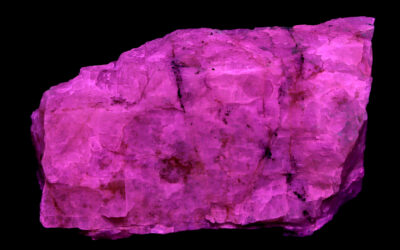
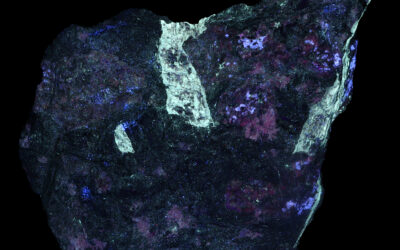
So, is fluorescence in rhodochrosite possible? Yes, it is. This is the only example in my collection, a nice pink rhodochrosite plate from the N’Chwaning II Mine in Northern Cape, South Africa. It fluoresces red under both longwave and midwave UV light, and dimmer under midwave UV.

Fluorescence under logwave UV light.
Normal light.
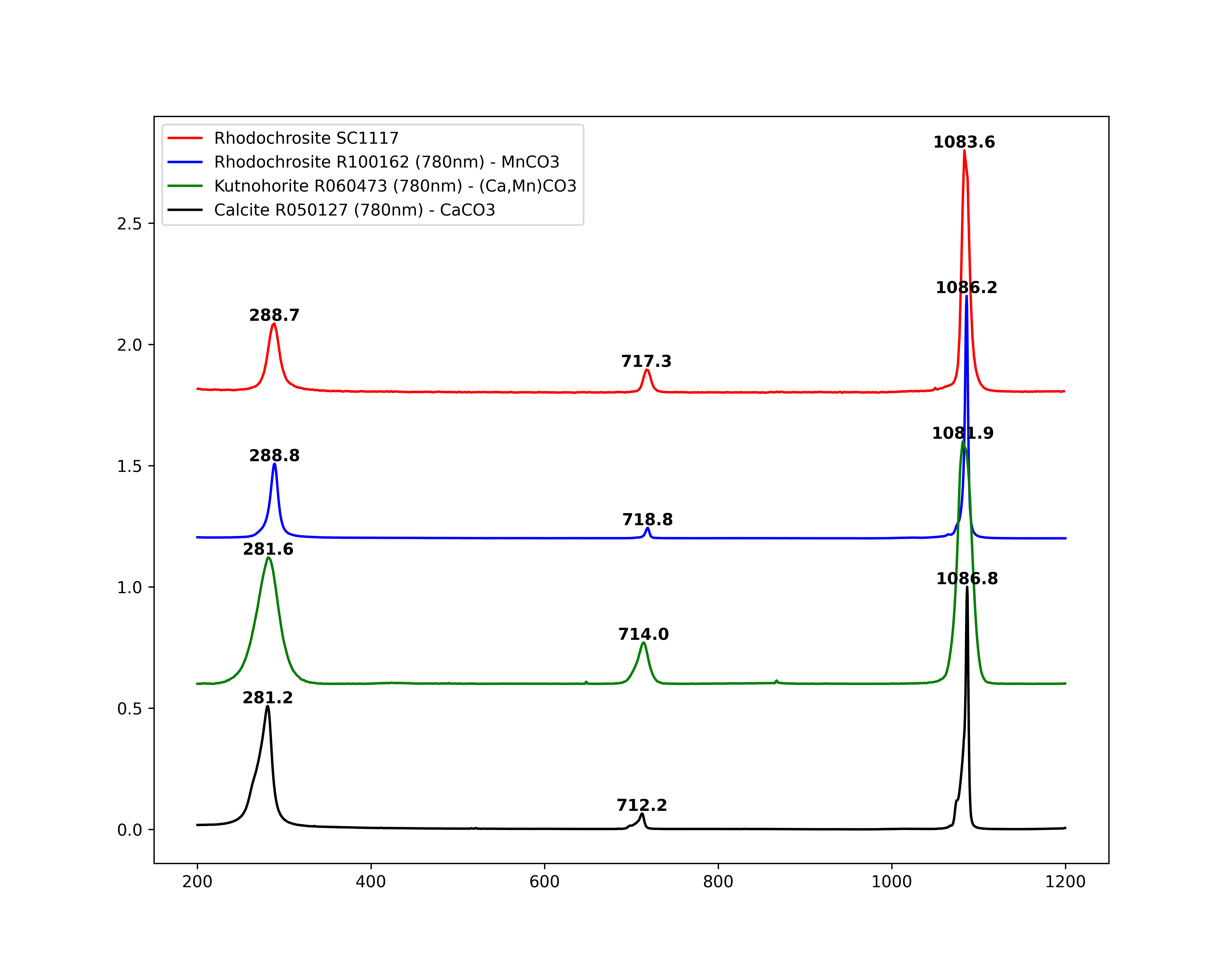
To verify its identity I measured its Raman spectrum and compared it to reference rhodochrosite, calcite, and kutnohorite, an in-between mineral with equimolar manganese and calcium content, MnCa(CO3)2. As you can see, all three spectra are very similar and hard to distinguish, but my sample matches best the rhodochrosite reference. Also note, Raman is not the best analytical technique in these cases. A quantitative elemental analysis like EDS would be much better to determine the amount of calcium and manganese present in the sample.

Raman spectra.

Fluorescent rhodochrosite in my collection:

No Results Found

The page you requested could not be found. Try refining your search, or use the navigation above to locate the post.

Hokkaidoite

Hokkaidoite

HokkaidoideSC1207 – Hokkaidoite from the Shikaribetsu Lake, Hokkaidō Prefecture, JapanFluorescence...

read more
Holtite

Holtite

HoltiteFluorescence under midwave and shortwave UV light.Normal light.Fluorescent holtite in my...

read more
Hyalite

Hyalite

Hyalite, the "bubbly" variety of opal. Typical fluorescence us bright green due to uranyl UO22+...

read more
Hydrozincite

Hydrozincite

Hydrozincite is secondary zinc mineral. Usually powdery white, it fluoresces bright light blue...

read more
Idrialite

Idrialite

Idrialite is an organic mineral usually found in mercury mines. It shows a very bright green...

read more
Kyanite

Kyanite

Kyanite often shows a dim red fluorescence under longwave UV light. This fluorescence is usually...

read more
Leucophanite

Leucophanite

LeucophaniteFluorescence under midwave and shortwave UV light.Normal light.Fluorescent...

read more
Lorenzenite

Lorenzenite

LorenzeniteFluorescence under midwave and shortwave UV light.Normal light.Fluorescent lorenzenite...

read more
Meliphanite

Meliphanite

MeliphaniteFluorescence under midwave and shortwave UV light.Normal light.Fluorescent meliphanite...

read more
Miserite

Miserite

MiseriteFluorescence under midwave and shortwave UV light.Normal light.Fluorescent miserite in my...

read more